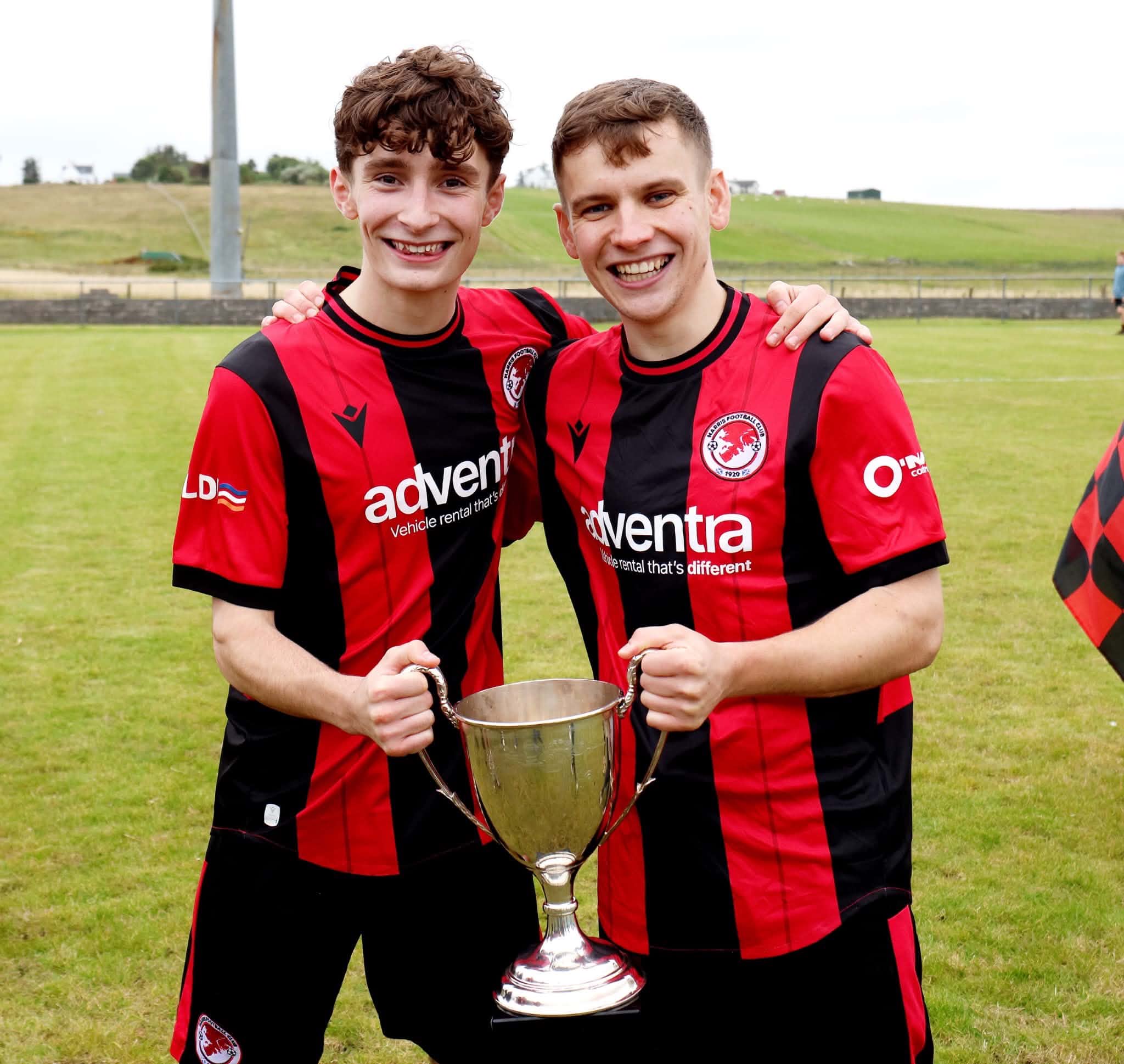
Congratulations to our co-manager Donnie and his Harris FC team-mates on lifting the Eilean an Fhraoich Cup (Donnie is pictured above with his cousin and namesake Domhnall Beag MacRae). This historic victory in the Island’s representative football competition by Na Hearaich and the shinty connection is a great opportunity to revisit one of the most interesting pieces of writing on shinty in Lewis and Harris. Of particular interest is that this piece comes from the dark days of the 1950s and 1960s when shinty had quite swiftly retreated from the social consciousness of many in the Western Isles despite it being played in school and at the New Year until the 1920s.
The Stornoway Gazette dated Tuesday 22 March 1960 carried a letter by a man, quite possibly from South Lochs, writing with the nom-de-plume of Clach Uaine and entitled “Shinty in Lewis”. It had been in response to the Gaelic correspondent “Dòmhnall Donn” – The Reverend Thomas MacCalman from Skye, wondering if there was ever any shinty in Lewis the previous issue. Clach Uaine writes:
Our Glasgow Gaelic correspondent, Dòmhnall Donn, may be interested to know that shinty was played in Lewis until fairly recent times; in fact until the game was drowned, during the 1920s in a wave of progress that emanated from the Nicolson Institute, Stornoway.
The body was recovered and given due and decorous internment by the Glasgow Lewis and Harris Association when they presented a cup to the Lewis Football Association for competition by the rural football teams.
In pre-1914 days each Lewis schoolbody took his caman to school with him during the winter months as surely as he took his books and his peat. Perhaps the game was not played in accordance with the published rules of the Camanachd Association but rules we had, and they had the sanction of long usage and the support of the boys themselves.
Our camans would not, even today, attract purchase tax, nor did they conform to any special pattern; that depended on the skill of the individual and of the material available. The most popular caman was the crook half of a walking stick. but there were not enought broken walking sticks (despite our many efforts) to provide each boy with a caman of this kind.
A cork from a herring net made an ideal playing ball and there were always plenty of stones for goal posts. The number of players in a team depended on the number of boys available, and at my school, teams were always chosen in accordance with an old established ritual.
Two of the older boys would assume leadership, and No. 1 would address No. 2 with the words “Buaileam Ort” to which No. 2 always replied “Leigidh mi leat”; and then No.1 would name his first choice. The nominee would move to the side of No. 1 and No. 2 then named with his first choice and so on until all the boys were included in the teams.
The games lasted as long as we wished, or as long as we were allowed to remain free from other duties at school or at home. A referee was not required.
Shinty playing was not restricted to schoolboys and I have stirring recollections of the inter-village games played on New Year’s Day.
“Them were the days” but alas they have now gone for always however much we of the older generation like nostalgically to recall them. Progress there must be, though it is questionable whether progress demands the suppression of what is local and native by what is foreign and strange
I wonder how long the boys will continue to enjoy “Oidhche Challuinn” and the girls “Oidhche Shannadh” in view of the support given by the “progressives” to Guy Fawkes Night and the Guisers.
Being a confirmed supporter of shinty and rugby games I am probably rather prejudiced againsst football which as a game I consider no sport at all., but a business where men are sold and bought like slaves, and where everything is done with an eye on the gate money.
Yours etc.,
CLACH UAINE, Inverness
Who Clach Uaine was is unclear, other than from his writings that he seems to certainly from South Lochs and is a learned man. In communication with Donnie Morrison of Comunn Eachdraidh na Pàirce, a few names were suggested with Dolina MacLennan thinking it might by Robert MacKenzie (Rob Sheòrais Iain) of 14 Marvig who was a scholarly teacher, but spent most of his career in Plockton and Applecross. There was also a suggestion in the Marvig – Capital of Lochs group that there is a landmark known as Allt na Cloiche Uaine between Kershader and Garyvard and this may be where the nom-de-plume comes from so it may be some unknown person from further that way. However, there is also a Clach Uaine at the north tip of Eilean Mhuire in the Shiants and Rob did have experience of going to hunt puffins there in the 1930s.
Whether it was Rob, or someone else, who was the mysterious Clach Uaine who made a stand for shinty as an integral part of Leòdhasach tradition during the camanachd dark ages it doesn’t really matter. What matters is that they drew attention to the impact that various social forces had on the native sport and gave us a picture of what shinty looked like in the early years of the twentieth century. When the Eilean an Fhraoich was gifted in the 1930s, shinty was very much in decline in the islands, but certainly areas such as Tolsta, Uig and South Lochs were keen on the sport until around that time and it’s tantalising to think what some support for formal competition between areas might have brought about.
Shinty is of course back alive and swinging in Lewis and Harris, long after the “drowning” and the “decorous burial” thanks to the efforts of many hardworking people. Perhaps one day the Glasgow Lewis and Harris Association might see fit to provide a trophy (probably not as handsome and silvery as the football cup) to mark the revival of the sport of the Gael in Eilean Fraoich!